
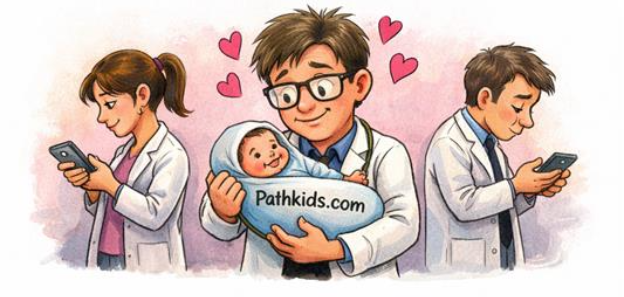
 20 years ago, Pathkids.com was conceived by a trainee pathologist with more enthusiasm than foresight. It has since grown up, alongside the internet itself from static websites to Facebook groups and X, and I would like to think it has quietly helped educate pathologists, solve diagnostic puzzles, and connect to a curious global community.
A Child Is Born. Pathkids.com recently celebrated its 20th birthday. I didn’t buy my child a present. I didn’t even celebrate (or remember) its 18th. In fact, many years have passed without me pausing to remember quite how proud I once was of this child, conceived and reared while I was a trainee pathologist.
The name came to me when I was regional training lead in the Southwest. I remember thinking: “We are the kids who do path, we are the Pathkids!” I registered the domain name pathkids.com and decided to host our regional training diary on it.
Before the website existed, organising teaching was an exercise in collective amnesia. We phoned or emailed around asking questions like:
“Do you remember what so-and-so taught about last year?”
“Have we had any pancreatic or bone and soft tissue teaching recently?”
“Did anyone get the PowerPoint slides from Dr Rigormortis’s talk?”
The person who had carefully scribbled down the list of topics had invariably left the scheme, become a consultant somewhere else, or was far too busy revising for exams to locate the random email with the Word document attached (or the beer mat on which last year’s teaching topics were scrawled).
The Over-Attentive Parent Phase. For years, I diligently uploaded not only the list of topics taught each month but also linked PowerPoint slides, occasional whole slide images, and photographs for each training day. I even created an “auto-upload” page that allowed other trainees to upload the invariably enormous PowerPoint file that the presenter didn’t know how to compress or email; files so large they appeared to be measured in astronomical units rather than megabytes.
Like all histopathologists, we love lists. We catalogue cases and diagnoses in the same way birdwatchers log rare bitterns or trainspotters record the last Class 55 Deltic they saw thunder past. I didn’t really care that 99% of trainees probably never looked at the website, or thought it was ugly. Like any new parent convinced their child is beautiful and exceptional, I felt exactly the same about my beloved Pathkids.com.
Adolescence: Enter Social Media. When Pathkids was a few years old, something called social media arrived and promptly distracted attention away from my baby. Thinking “if you can’t beat ’em, join ’em”, I promptly created a Pathkids Facebook page.
To my surprise, it became very popular, amassing several thousand members within a few years. But rather than chasing numbers, I wanted quality contributions or at least entertaining interaction (which arrived in bucketloads from a few familiar names, notably Rob Hadden and Zlatko Marusic).
To keep out hackers, spambots, and robot AIs, I vetted applicants with questions such as:
“Where did you train in laboratory medicine?”
“What is your favourite histochemical stain?”
My ultimate aim was for trainees to be most involved: sharing exam tips, cases, and experiences, and occasionally asking opinions from some of us old farts. Yet even after the group became well established, I would receive shy emails from senior trainees or consultants asking if I could possibly post a question or advert on their behalf.
“But why don’t you post it yourself?” I would ask. “You’re a member of the group!”
Despite encouragement, the group remains active largely due to a relatively small core of friends and colleagues, some of whom happen to be international experts. The majority remain silent observers. This is a shame, as I have always found interactive learning far more powerful and enduring than passive consumption.
Diagnoses Made at a Distance
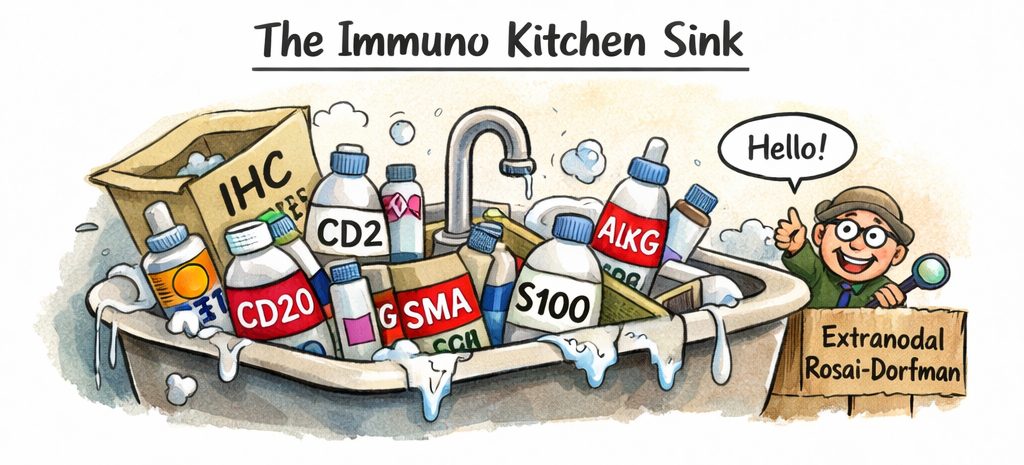 That said, some of my most satisfying diagnoses, and diagnostic rescues have come directly from discussions in the group. I vividly remember an early case: a biopsy from the neck of a patient with a diffuse, expanding mass. I had exhausted the entire immunohistochemical kitchen sink; lymphoreticular markers, mesenchymal markers, even IgG4, and was close to conceding it was a non-specific fibroinflammatory process. The clinical team, however, remained uneasy, and I have never learned to ignore the instincts of trusted clinical colleagues.
I reached out to the group. Despite having only mediocre images to share, Fernanda Amary suggested extranodal Rosai–Dorfman disease. The moment I read her comment, I knew she was right. It was simply a matter of finding that elusive focus of S100-positive emperipolesis, which I duly found the following day!
There have been many similar cases since: rare, interesting, and educational. Colleagues and I have learned from them, and more importantly patients have benefitted from our collective expertise.
The Accidental Social Media Enthusiast. I have now acquired a reputation as a “social media enthusiast” within our niche specialty. In truth, I might have preferred to be known as a conventional academic expert. Despite an academic background, I was realistically never going to become a Professor while living in the extreme South West, memorably described by a now-retired colleague as a place where “one would be more successful going up a tree to learn pathology than going to Cornwall.”
Some of my hardest-won research papers may have attracted more readers had they been deposited in a library on Alpha Centauri. There is therefore a quiet satisfaction in knowing that a single educational post on social media can reach hundreds sometimes thousands of colleagues within days.
The Leap Into X (Still Twitter, to Me)
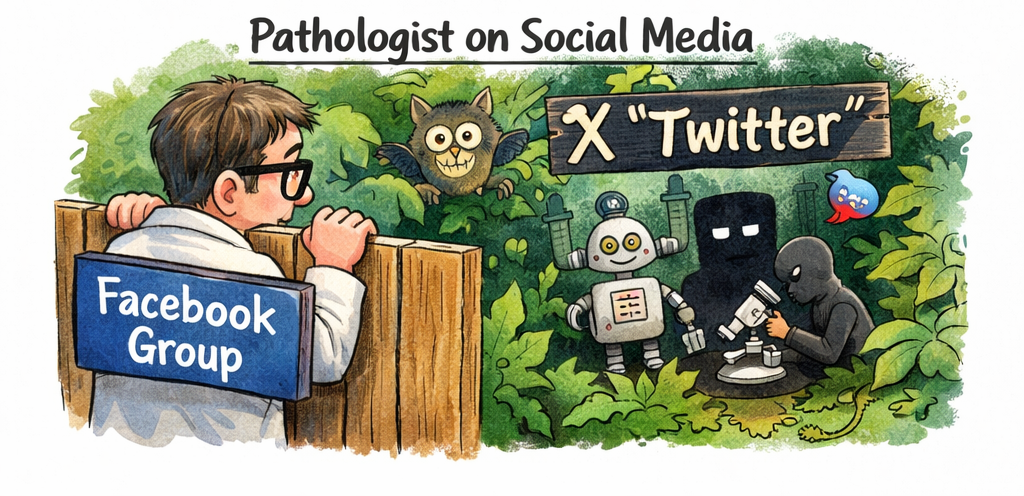 There are many other platforms; Instagram, TikTok, YouTube which I have neither the time nor enthusiasm to master. I did, however, venture into what was recently described as “Elon Musk’s online cesspit”: X (formerly Twitter, and always Twitter to me).
Moving from the relative safety of a carefully vetted Facebook group into an entirely open platform was unnerving. I only joined after my colleague Rob Hadden created a Pathkids account and began posting on my behalf, prompting me to investigate, largely to ensure he wasn’t damaging my baby.
To my surprise, the #PathTwitter community proved thoughtful, generous, and deeply knowledgeable. Through it, I’ve connected with international experts I now count as friends, met colleagues in person at conferences, hosted trainees on fellowships, and contributed to collaborative case reports and series arising from anonymised posts.
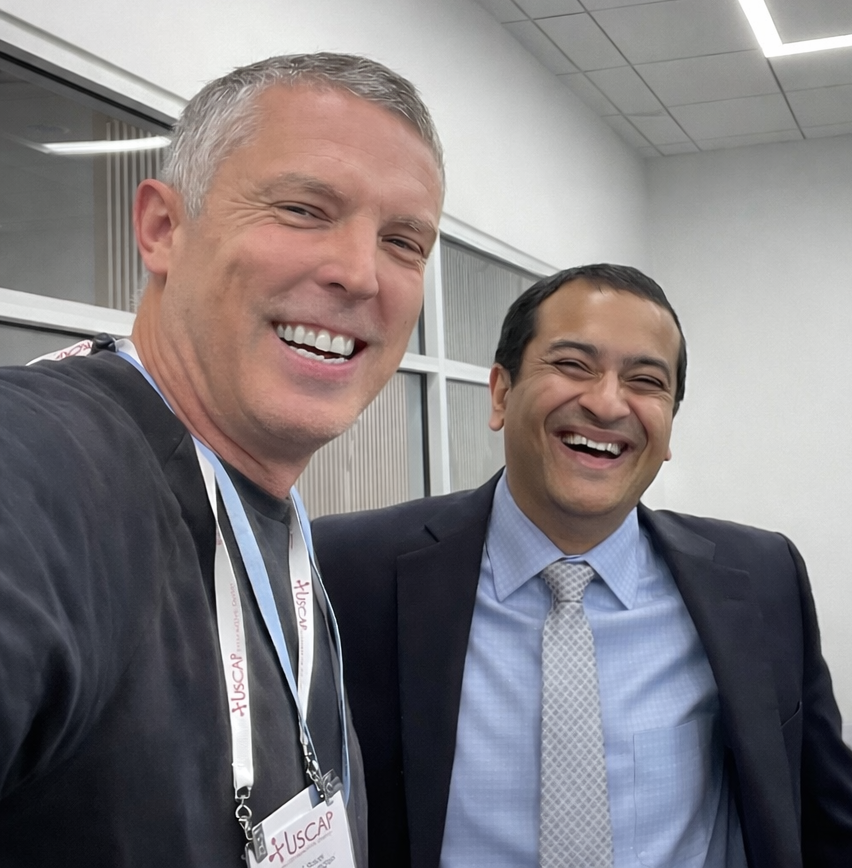 | 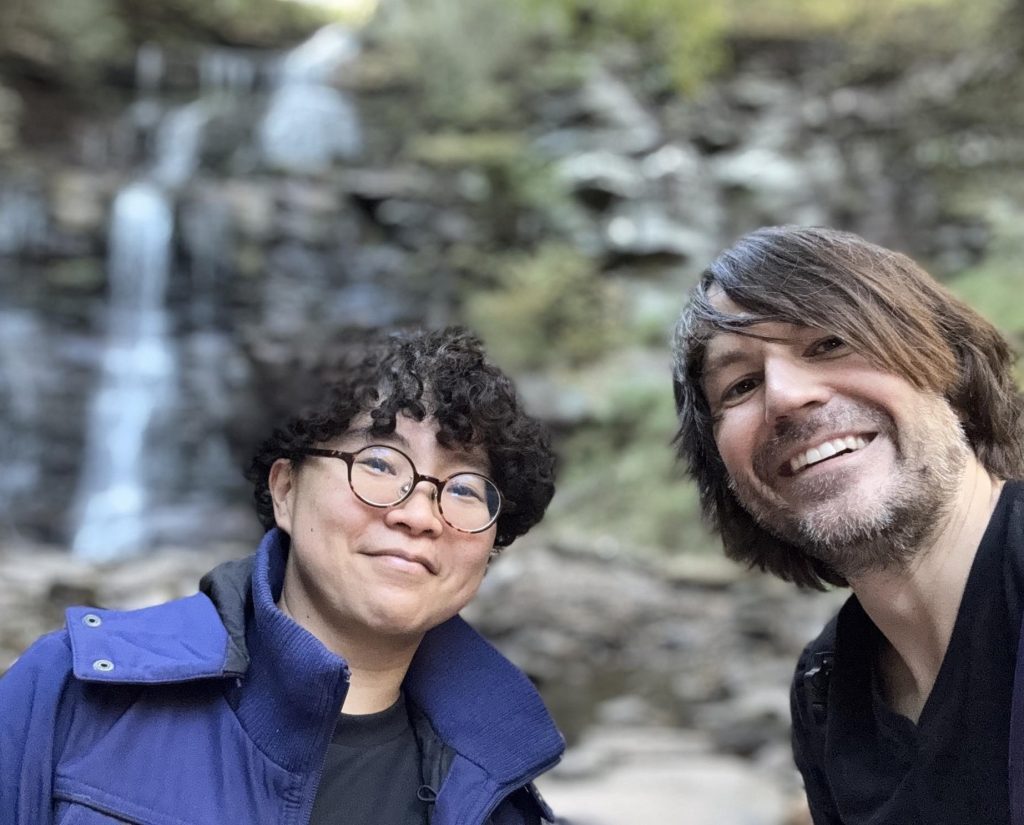 |
| Tim and Sanjay Mukhopadhyay catching up at USCAP Palm Springs | Kris Leung’s fellowship with Jerad Gardner also included a hiking trail with waterfalls near his home! |
I’ve even had colleagues tell me that following my social media posts influenced their decision to apply for posts in our department. It is now common to be approached at conferences by someone I’ve never met, whose name I recognise instantly from online interactions.
Conclusion: A Grown-Up Child
Social media is unquestionably a potentially damaging place, particularly for young minds. But when used carefully and professionally, it can be a powerful tool for education, collaboration, and community-building.
Pathkids has grown up alongside the internet itself. I may not always remember its birthdays, but I remain quietly proud of what it has become — a slightly scruffy, occasionally noisy, but fundamentally generous space where pathologists continue to learn from one another.
Not bad for a child conceived by a trainee with a domain name and an idea?